By Mike Armstrong
Reporter, Carbon County Comet
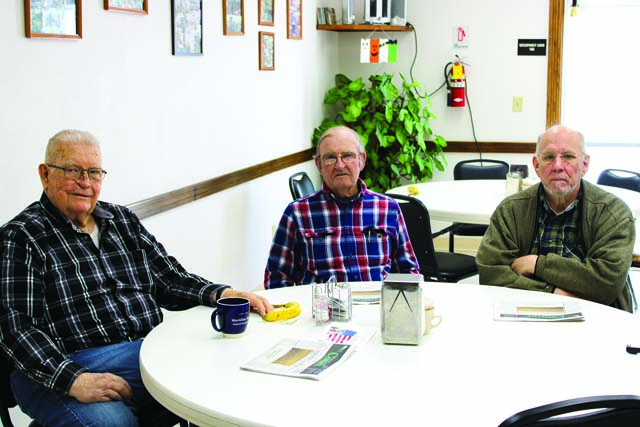
Donald Mayfield said he is not an ex-marine, but rather a marine even though it has been since the Korean War that he served.
“Once a marine, always a marine,” Mayfield laughed. “I was in the military from 1954 until 1962. Back then you served eight years. I was three years in active duty and five years in the active reserve.”
Mayfield said he spent nine months in Korea and the rest of his time in service at Camp Pendleton, California.
He was born in Colorado in 1935 but came to Carter, Wyoming in 1941. His family moved around some in Wyoming in his early years but ended up in Medicine Bow in 1947. Except for his time in the military, he has lived most of his life in the small town in northern Carbon County.
Mayfield remembers his first night in Inchon, Korea, in February of 1954. The war had started in June of 1953, but by 1954 there was a tentative cease-fire. He was so close to the enemy, he could see them practicing their drills two miles away. Mayfield joked on his first night, he was told if he heard a siren go off to get under his cot.
“We were all housed in a big tent and if sirens were sounded we were supposed to get under our cots, but being under a cot wasn’t going to do a lot of good,” Mayfield laughed. “It was a canvas tent and a canvas roof, so you would just lay there.”
His strongest memory of an incident was when he was walking down the road and a jeep drove by and he was grabbed, spun around and thrown to the ground. As he went face down, all he heard was Korean.
“One of the guys jumped out of the jeep and I rolled up with my gun pointed out to shoot, but his fellow soldiers pulled him back into the jeep,” Mayfield said. “This was near the DMZ (demilitarized zone) and I didn’t know who it was. To this day I don’t know who it was. I just had my gun ready as I saw the wheels of the jeep spinning around to get out of there. I lay there until they were about a mile away. It was a pretty exciting moment but it had my heart beating.”
He said the way the Marines told him to control his fear, was to consider himself dead and to take as many as the enemy that he could.
Keith Thomas had a very different job when he served in the military.
“I had to join the Army to destroy nuclear bombs in Alabama,” Thomas said. “The work where this took place was in a tank factory. We actually just rebuilt old tanks. Trainloads came in of old burnt-out tanks and we just fixed them up for combat.”
At first, he worked on the tanks.
“I was building transfer gears at first, in the transfer case that turns the turret,” Thomas recollected. “Then they got the contract to destroy nuclear bombs and they put me in process improvement in the nuclear bomb destruction area. So we destroyed nuclear bombs.”
He said it was a four-year deal. He did this from 2005 until 2010. Thomas said several thousand people were working to destroy these bombs. Thomas sort of jokes that the army microwaved them all to get them to do this job.
“They microwaved soldiers. A whole unit would be marching and they would microwave them and then the guys would start spinning around,” Thomas said. “A few minutes later, they would start walking around like nothing happened.”
He said microwaves are on tanks.
“That is something not everyone knows about,” Thomas said. “Some tanks are rebuilt that are out of date, but a microwave on it really updates it pretty quickly. The microwave is pointed at the enemy and it sends them to cuckoo land. There are no rules when it comes to war.”
Back to the nuclear bombs, Thomas said he helped destroy thousands.
“Not hundreds, thousands,” Thomas said. “A bomb might look like a tank, it might look like a Volkswagen, but it was a bomb.”
His memory of this time is not of his work with the nuclear bombs, but with a tank they were testing.
Thomas had put in three bags of powder in the gun and his buddy put in five bags. He was supposed to put in two bags. Thomas remembers the tank jumping in the air several feet and then the smoke made it impossible to see the tank for several minutes.
Rex Rudd served in the Navy during the Vietnam War.
Rudd went to college in the ROTC and then went into the Navy and went to submarine school in Groton, Connecticut. He served on a diesel sub that made a trip to Vietnam and came back.
“Then I served on a heavy cruiser, the St. Paul, which made three trips to Vietnam,” Rudd said. “We set a record for naval gun support fire power that will probably never be broken. 65,000 rounds in a 103 days.”
The 23-year-old St. Paul shot a total of 93,000 rounds in the Vietnam War.
Rudd started as a cook.
“We made a hundred pies and other stuff in the morning and then at night, we made so much food. I was in charge of three freezers of food just myself. Then there were several cooking areas for prep and making food, and I was in charge of that. It was an important job. I was picked as sailor of the month one time for my work,” Rudd said. “It was 1968 and being on this amazing ship has so many memories, not just one pops out.”
Rudd served in the Navy for four years, eight months and one day.
Mayfield remembers going through chemical warfare school.
“That was interesting,” Mayfield said. “You had to sing the “Battle Hymn of the Republic, while they tear-gassed you.”
Thomas remembers a beautiful green cloud that would appear when destroying the nuclear bombs.
“It was all colors of green except dark. There was a pinkish middle,” Thomas recalled. “It just went up in the sky and I wondered where it was going to fall because I lived in the city nearby. I know my dad had to replace roof after roof. I couldn’t help wondering what it might be doing to the people living nearby.”
All agree the military has changed quite a lot since each had served.
Drones have changed everything they all agreed.
They also agreed it was an interesting time in their lives.
Mayfield summed up the experience very well.
“I wouldn’t take a million dollars for what I’ve seen,” Mayfield said. “But I wouldn’t give a nickel to see it again.”